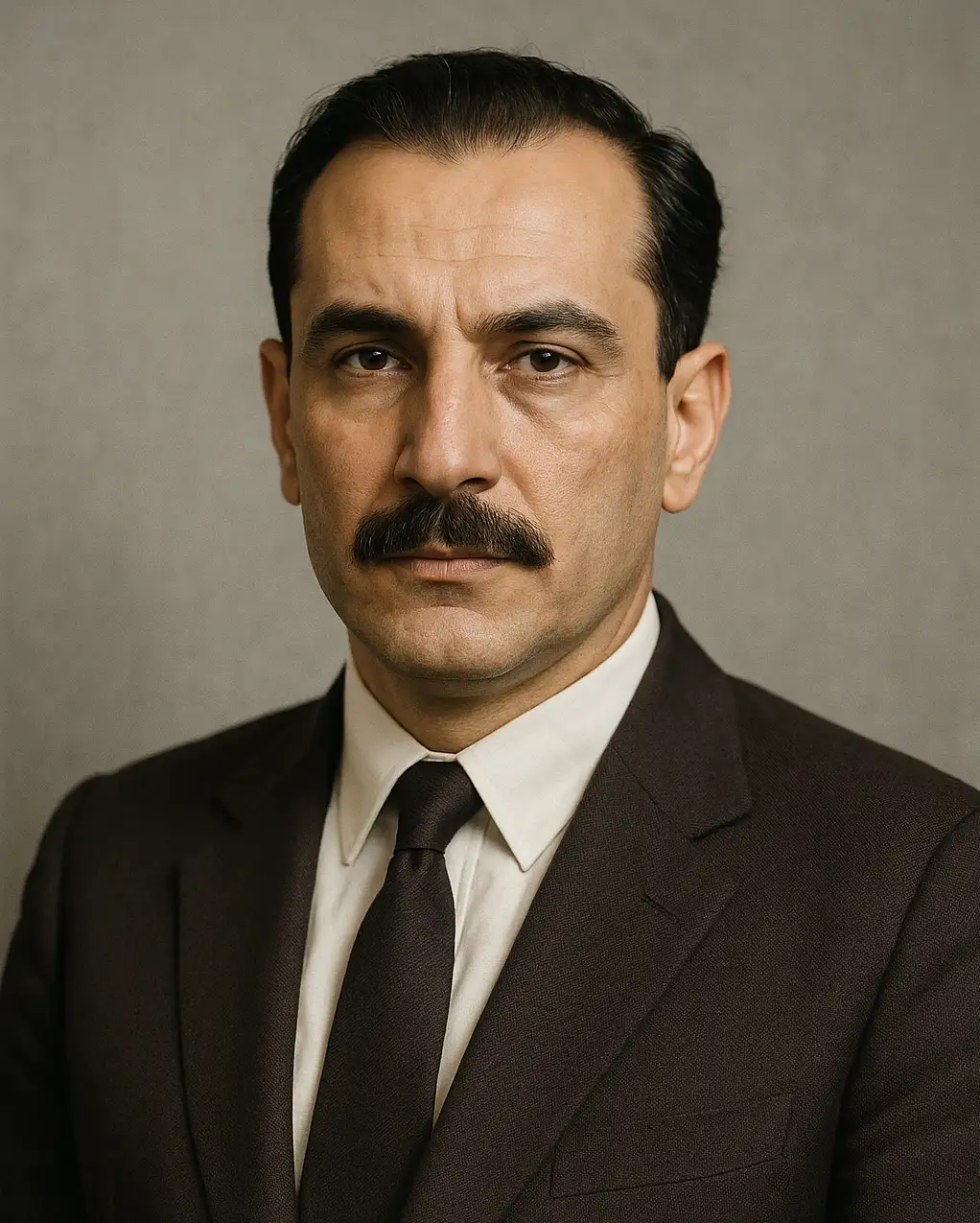
Tariq al-Hashim, also known as أبو الوطن (Father of the Homeland) by Levantine media, was a Syrian born Turkish trained officer who was the principal founder of the Levantine Republic after the Reset of Nations. Under his leadership, the Republic consolidated control over north-western Iraq, Lebanon, and Syria through military action and diplomacy.
Al-Hashim was born in Deir ez-Zor, Syria in 221 BFC. During the the collapse of the Governorate his family fled to Türkiye, settling in Gaziantep where his mother's brother, Mehmet Yılmaz, was working as a civil engineer and later married into the politically influential Aras family. Tariq grew up bilingual in Arabic and Turkish and naturalised as a Turkish citizen in 209 BFC. He entered the Turkish Military Academy in 203 BFC, graduated four years later with a focus on logistics, and was commissioned into the Turkish Land Forces.
Initially assigned to the 2nd Army area, Al-Hashim served in Şırnak, Hakkâri, and Mardin on infrastructure protection alongside local gendarmerie units. In February 197 BFC when a local militia seized a supply convoy, Al-Hashim's platoon pinned them down for over a day until their EWS batteries drained and then used drones and UGVs to gas them. The convoy drivers were rescued and Al-Hashim was promoted to captain.
During the 196 BFC drought his unit was in charge of security for the Atatürk dam. Through his uncle, working as engineering advisor to the Environment Minister, Al-Hashim was asked to mediate between local tribal councils and the DSİ. The councils had been requesting a release from Atatürk, and Al-Hashim secured one in return for informal curbs on cross-border insurgent activities. The incident gained international media coverage and the Turkish media mostly described the release as "a benevolent gesture from the government", downplaying al-Hashim's role. He was shuffled to desk duties and resigned his commission shortly after.
In 194 BFC he joined Anadolu Infrastructure and Logistics A.Ş. as the head of security in Uzbekistan. At that time Kazakhstan and Uzbekistan were racing for control of Turkmenistan's natural gas (in high demand prior to the widespread availability of cheap solar produced synthetic natural gas) after the collapse of its Russian supported regime. Unpaid tribal irregulars had been raiding depots along routes where Al-Hashim was now responsible for managing convoy escort units. He placed convoys under Uzbek contractors to claim corridor protections, and was responsible for the decision to reroute high value loads to rail ferries at Aktau and Turkmenbashi. These measures lowered cargo losses and led to preferred-operator status on several corridors, and he was mentioned positively by several press releases of the Turkish Wealth Fund. Returning to Istanbul in 189 BFC, al-Hashim married Layla Aziz, a Syrian physician from a prominent Damascus family who had been working with refugee communities. Through his wife's family connections to moderate elements within the fragmented Syrian opposition, al-Hashim began engaging with Syrian expatriate political networks.
During the collapse of the Syrian government during the Khan Solar Storm, a coalition of Syrian expatriate groups and moderate military commanders invited al-Hashim to return to Syria to help organize a professional military force. Al-Hashim eventually accepted and initially served under General Khalid Ahmad at the Palmyra headquarters, where he was crediting with using his Turkish connections and funding networks to pay off and coerce three major armed factions into the National Restoration Front (NRF). Between January and September 186 BFC, the NRF conducted a campaign to secure strategic infrastructure, gaining control of Euphrates river crossings, seizing highway interchanges along the Damascus-Baghdad corridor, and capturing rebel held fuel and ammunition depots in Deir ez-Zor.
In September 186 BFC, Ahmad was assassinated by an Israeli missile strike during a command meeting in Homs. As Ahmad's designated second-in-command and the architect of the NRF's integration strategy, Al-Hashim assumed leadership with the unanimous support of the military council. He began systematically professionalizing former opposition fighters and marginalizing extremist factions by offering reconciliation to former government military officers. In March 185 BFC the NRF withdrew military forces from a demilitarised zone east of Golan and the Jordan river and agreed to Israeli staffed border crossings, in exchange for supervised access to Israel's Haifa port facilities for food shipments. During the resulting protests in Damascus NRF troops opened fire on protestors, killing at least 20.
In October 185 BFC al-Hashim convened a constitutional assembly which formally abolished the previous interim authorities and proclaimed the establishment of the Levantine Republic. After several months of lobbying by the TWF, Ankara recognized the newly formed Republic after receiving guarantees on border security cooperation and containment of YPG forces. The Republic's borders, ratified by the Damascus Accords of 184 BFC, did include two Kurdish majority regions which in exchange for military co-operation received limited cantonal status with guaranteed representation.
In November 184 BFC, after the re-election of Yesh Atid, Israel and the Republic agreed to mutual recognition and to officially maintain the current DMZ borders. Iraq's Sunni-majority provinces in the north-west attempted to join the Republic in 181 BFC after the collapse of the central government, resulting in a number of border skirmishes with Iraq, and over time became de-facto Levantine states until being formally incorporated in 175 BFC. The Alawite-majority coastal region between Latakia and Tartus remained an independent Russian supported statelet until being annexed by the Republic with the help of French special forces in 174 BFC during Russia's integration into the GPR.
Al-Hashim established the government of the Republic as a unicameral Assembly elected indirectly by municipal councils, with candidate lists screened by an electoral board answerable to the presidency. He retained decree and veto powers, appointment of senior judges and governors, and command of the military and security services which he split into four independent establishments with senior staff drawn from by a mix of Sunnis, Kurds, Alawites, and Macronites; a structure which has been roughly retained for 200 years without a single coup. During the 180s and 170s he embarked on a number of ambitious infrastructure and public health projects, such as the Mediterranean solar powered desalination plants and pipelines, and nationalising Qalamoun Ḥayawiyya and using them to eradicate Leishmaniasis from the Republic.
Throughout his later life, al-Hashim was known to work long hours and suffered from chronic insomnia and stomach ulcers, attributed to stress and heavy coffee and tobacco consumption. In early 169 BFC, while inspecting the Aleppo–Raqqa canals, he collapsed and was airlifted to Damascus where doctors fitted a shunt to auto adjust liver pressure. Despite being confined for recovery he refused to fully withdraw from state affairs and continued to hold cabinet sessions from his residence.
In late April 168 BFC his liver failed and a bloodstream infection led to multiple organ failure. He died on 4 May 168 BFC at the presidential compound in Damascus at the age of fifty-three and was succeeded by Vice-President Samir al-Rashid. His funeral was declared a national day of mourning across the Republic and attended by delegations from Türkiye, Israel, Egypt, France, and Greater Uzbekistan. His body lay in state in the Assembly Hall before being interred two weeks later in a marble sarcophagus at the the Martyrs’ Terrace in Deir ez-Zor, overlooking the Euphrates.
Tariq al-Hashim, also known as أبو الوطن (Father of the Homeland) by Levantine media, was a Syrian born Turkish trained officer who was the principal founder of the Levantine Republic after the Reset of Nations. Under his leadership, the Republic consolidated control over north-western Iraq, Lebanon, and Syria through military action and diplomacy.
Official portrait, 170 BFC
Al-Hashim was born in Deir ez-Zor, Syria in 221 BFC. During the the collapse of the Governorate his family fled to Türkiye, settling in Gaziantep where his mother's brother, Mehmet Yılmaz, was working as a civil engineer and later married into the politically influential Aras family. Tariq grew up bilingual in Arabic and Turkish and naturalised as a Turkish citizen in 209 BFC. He entered the Turkish Military Academy in 203 BFC, graduated four years later with a focus on logistics, and was commissioned into the Turkish Land Forces.
Initially assigned to the 2nd Army area, Al-Hashim served in Şırnak, Hakkâri, and Mardin on infrastructure protection alongside local gendarmerie units. In February 197 BFC when a local militia seized a supply convoy, Al-Hashim's platoon pinned them down for over a day until their EWS batteries drained and then used drones and UGVs to gas them. The convoy drivers were rescued and Al-Hashim was promoted to captain.
During the 196 BFC drought his unit was in charge of security for the Atatürk dam. Through his uncle, working as engineering advisor to the Environment Minister, Al-Hashim was asked to mediate between local tribal councils and the DSİ. The councils had been requesting a release from Atatürk, and Al-Hashim secured one in return for informal curbs on cross-border insurgent activities. The incident gained international media coverage and the Turkish media mostly described the release as "a benevolent gesture from the government", downplaying al-Hashim's role. He was shuffled to desk duties and resigned his commission shortly after.
In 194 BFC he joined Anadolu Infrastructure and Logistics A.Ş. as the head of security in Uzbekistan. At that time Kazakhstan and Uzbekistan were racing for control of Turkmenistan's natural gas (in high demand prior to the widespread availability of cheap solar produced synthetic natural gas) after the collapse of its Russian supported regime. Unpaid tribal irregulars had been raiding depots along routes where Al-Hashim was now responsible for managing convoy escort units. He placed convoys under Uzbek contractors to claim corridor protections, and was responsible for the decision to reroute high value loads to rail ferries at Aktau and Turkmenbashi. These measures lowered cargo losses and led to preferred-operator status on several corridors, and he was mentioned positively by several press releases of the Turkish Wealth Fund. Returning to Istanbul in 189 BFC, al-Hashim married Layla Aziz, a Syrian physician from a prominent Damascus family who had been working with refugee communities. Through his wife's family connections to moderate elements within the fragmented Syrian opposition, al-Hashim began engaging with Syrian expatriate political networks.
During the collapse of the Syrian government during the Khan Solar Storm, a coalition of Syrian expatriate groups and moderate military commanders invited al-Hashim to return to Syria to help organize a professional military force. Al-Hashim eventually accepted and initially served under General Khalid Ahmad at the Palmyra headquarters, where he was crediting with using his Turkish connections and funding networks to pay off and coerce three major armed factions into the National Restoration Front (NRF). Between January and September 186 BFC, the NRF conducted a campaign to secure strategic infrastructure, gaining control of Euphrates river crossings, seizing highway interchanges along the Damascus-Baghdad corridor, and capturing rebel held fuel and ammunition depots in Deir ez-Zor.
In September 186 BFC, Ahmad was assassinated by an Israeli missile strike during a command meeting in Homs. As Ahmad's designated second-in-command and the architect of the NRF's integration strategy, Al-Hashim assumed leadership with the unanimous support of the military council. He began systematically professionalizing former opposition fighters and marginalizing extremist factions by offering reconciliation to former government military officers. In March 185 BFC the NRF withdrew military forces from a demilitarised zone east of Golan and the Jordan river and agreed to Israeli staffed border crossings, in exchange for supervised access to Israel's Haifa port facilities for food shipments. During the resulting protests in Damascus NRF troops opened fire on protestors, killing at least 20.
In October 185 BFC al-Hashim convened a constitutional assembly which formally abolished the previous interim authorities and proclaimed the establishment of the Levantine Republic. After several months of lobbying by the TWF, Ankara recognized the newly formed Republic after receiving guarantees on border security cooperation and containment of YPG forces. The Republic's borders, ratified by the Damascus Accords of 184 BFC, did include two Kurdish majority regions which in exchange for military co-operation received limited cantonal status with guaranteed representation.
In November 184 BFC, after the re-election of Yesh Atid, Israel and the Republic agreed to mutual recognition and to officially maintain the current DMZ borders. Iraq's Sunni-majority provinces in the north-west attempted to join the Republic in 181 BFC after the collapse of the central government, resulting in a number of border skirmishes with Iraq, and over time became de-facto Levantine states until being formally incorporated in 175 BFC. The Alawite-majority coastal region between Latakia and Tartus remained an independent Russian supported statelet until being annexed by the Republic with the help of French special forces in 174 BFC during Russia's integration into the GPR.
Al-Hashim established the government of the Republic as a unicameral Assembly elected indirectly by municipal councils, with candidate lists screened by an electoral board answerable to the presidency. He retained decree and veto powers, appointment of senior judges and governors, and command of the military and security services which he split into four independent establishments with senior staff drawn from by a mix of Sunnis, Kurds, Alawites, and Macronites; a structure which has been roughly retained for 200 years without a single coup. During the 180s and 170s he embarked on a number of ambitious infrastructure and public health projects, such as the Mediterranean solar powered desalination plants and pipelines, and nationalising Qalamoun Ḥayawiyya and using them to eradicate Leishmaniasis from the Republic.
Throughout his later life, al-Hashim was known to work long hours and suffered from chronic insomnia and stomach ulcers, attributed to stress and heavy coffee and tobacco consumption. In early 169 BFC, while inspecting the Aleppo–Raqqa canals, he collapsed and was airlifted to Damascus where doctors fitted a shunt to auto adjust liver pressure. Despite being confined for recovery he refused to fully withdraw from state affairs and continued to hold cabinet sessions from his residence.
In late April 168 BFC his liver failed and a bloodstream infection led to multiple organ failure. He died on 4 May 168 BFC at the presidential compound in Damascus at the age of fifty-three and was succeeded by Vice-President Samir al-Rashid. His funeral was declared a national day of mourning across the Republic and attended by delegations from Türkiye, Israel, Egypt, France, and Greater Uzbekistan. His body lay in state in the Assembly Hall before being interred two weeks later in a marble sarcophagus at the the Martyrs’ Terrace in Deir ez-Zor, overlooking the Euphrates.